ITIL® Managing Professional Transition (Version 5) Certification Training Course-Global Launch


Training
on LMS
Run Batches
Instructors
Simulation
Support
Training
on LMS
Run Batches
Instructors
Simulation
Support
ITIL® Managing Professional Transition (Version 5)
 30% off
-
✓
Training Material
-
✓
LMS Access
-
✓
Video Recorded Sessioni
-
✓
Instructor-Led Virtual Classroom Training
-
✓
1 Year K-Prime Warrantyi
-
✓
3 Free Courses On LMSi
ITIL Managing Professional Transition (Version 5)
- Format: MCQs (Standard, Missing Word, List, Negative).
- Scenario: ITIL Car Rental case study.
- Duration: 120 minutes (150 minutes for non‑native languages).
- Questions: 60.
- Pass Mark: To be confirmed (TBC).
- Bloom’s Levels: BL1–BL4.
- Open Book: ITIL Product, Service, and Experience Official Books.
ITIL Transformation (Version 5)
- Format: MCQs (Standard, Missing Word, List, Negative).
- Scenario: Transformation case study.
- Duration: 90 minutes (113 minutes for non‑native language).
- Questions: 40.
- Pass Mark: 28/40 (70%).
- Bloom’s Levels: BL1–BL4 (60% BL2, 35% BL3, 5% BL4).
- Open Book: ITIL Transformation Official Book.
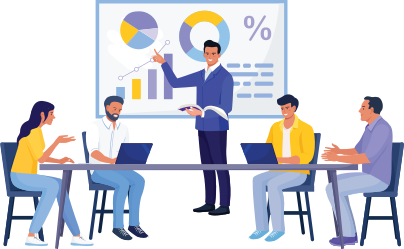
Advance your career with Knowlathon’s Live Instructor-Led/Classroom Training, designed for professionals who prefer interactive and structured learning.
Gain practical insights, real-time engagement, and expert guidance to confidently clear certification.
Learn at your own pace with Knowlathon’s On-Demand Training Programs - ideal for busy professionals who need flexibility without compromising quality.
Help your teams grow with personalized training programs and affordable pricing that fit your business goals. Build a future-ready workforce by boosting digital skills, technical know-how, and a mindset of continuous improvement.
Course Overview
The ITIL® Managing Professional Transition (Version 5) course is a comprehensive fast‑track program designed for advanced ITIL professionals. It enables holders of ITIL v3 Expert, ITIL v3 Master, ITIL 4 Managing Professional, or ITIL 4 Master certifications to transition into ITIL Version 5 without completing all modules individually.
The course consolidates the ITIL Product, Service, Experience, and Transformation modules, equipping professionals to manage digital products and services, integrate human experience, and lead enterprise transformation in an AI‑driven world.
Learning Objectives
By the end of this course, participants will be able to:
- Explain ITIL guiding principles, the ITIL Value System, and the Four Dimensions of Product and Service Management.
- Define digital products and services, and describe their lifecycle management activities.
- Apply the eight lifecycle activities (discover, design, acquire, build, transition, operate, deliver, support) to both product and service contexts.
- Integrate human experience into service design and delivery using the ITIL Experience Model.
- Map stakeholder journeys, service relationships, and experience domains.
- Apply the ITIL Transformation Model (governance, positioning, execution, learning) and common transformation patterns.
- Use measurement, evidence, and continual improvement loops to drive transformation success.
- Evaluate the role of AI in governance, product/service management, and digital ethics.
- Position ITIL alongside DevOps and PRINCE2 for holistic organizational success.
Detailed Course Topics
1. Key ITIL Concepts & Foundations
- ITIL Guiding Principles (focus on value, iterative progress, collaboration, holistic thinking, simplicity, optimization).
- ITIL Value System (VS) and Four Dimensions of Product & Service Management.
- ITIL Product and Service Lifecycle overview.
- Outputs v/s Outcomes, Value Co‑creation, Costs, and Risks.
2. Digital Products and Services
- Characteristics of digital products (analogue, digitally supported, digitally enabled, purely digital).
- Characteristics of digital services and their dependency on digital products.
- Service offerings: goods, access to resources, service actions.
- Relationships between products, services, and value streams.
- Lifecycle management activities for products and services.
3. The ITIL Value Chain Activities
- Discover, Design, Acquire, Build, Transition, Operate, Deliver, Support.
- Practices enabling each activity and their role.
- Execution steps, outputs, and critical success factors.
- Metrics and recommendations for effective lifecycle management.
- Integration of lifecycle stages into value streams and operating models.
4. ITIL Experience
- Human responses: feelings, thoughts, bodily states.
- ITIL Experience Model: anticipation, perception, evaluation.
- Experience capture: stakeholders, tensions, domains (personal, functional, relational, contextual).
- Experience evidence: data tiers, signals, capture techniques, trustworthiness.
- Service journeys: explore, engage, offer, agree, onboard, co‑create, reflect.
- Stakeholder journeys: consumer v/s provider perspectives, anti-patterns, practical implications.
- Digital experience improvement: notice‑interpret‑hypothesize‑experiment loop, trust, and psychological safety.
5. ITIL Transformation
- Transformation defined: scope, disruptive vs uncertain change.
- Four layers: governance, positioning, execution, learning.
- Twelve stages of the Transformation Model.
- Contextual transformation: ordered, complex, chaotic, confused.
- Common patterns: initiation (regulatory, structural, tech‑driven, remediation, market demand), governance (BAU v/s transformation), and execution (implement, discover, contain).
- Tools and techniques: VSM, OKRs, ITIL Maturity Model, Theory of Constraints, RACI.
- Measurement and evidence: benefits, issues, progress tracking.
- Learning and knowledge transfer: signals, lessons, and integration into value system.
6. ITIL and AI
- ITIL AI Capability Model.
- AI governance supporting experience, transformation, and implementation.
- AI’s role in product, service, and experience management.
- Automation's impact on tools and methods.
- Digital ethics in AI governance.
7. ITIL and Other Frameworks
- ITIL and DevOps: complementary lifecycle management.
- ITIL and PRINCE2: project management alignment and integration.
 (1).avif)
.avif)
.avif)
.avif)
.avif)
.avif)