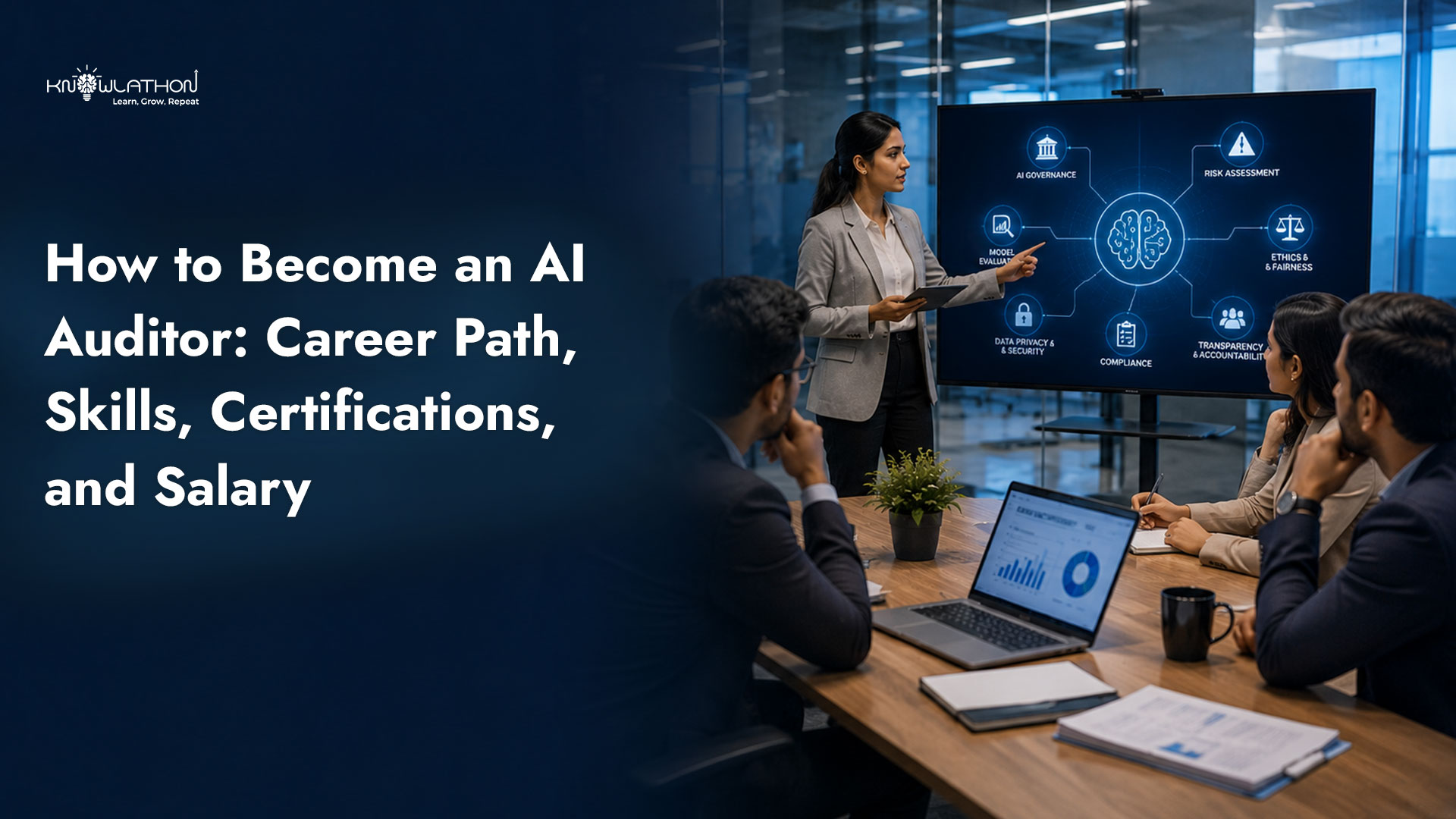
AI is sweeping across business like a tsunami. It sits behind decisions on loans and jobs, patient prioritisation in hospitals, and moderation of digital content. This swift adoption poses a problem: who is checking that these systems are ethical, legal and performing as expected?
This is precisely the niche of the AI auditor. It is a new profession still being defined across industries, but interest in it will rise rapidly as international standards tighten and executives realise that automated models are not self-governing.
At Knowlathon, we work with professionals pivoting into tech governance every day. If you want to build a future-proof career, understanding the AI audit career trajectory is a smart move. This guide breaks down what the job feels like on the ground, what skills you need, which credentials matter, and roughly what you can expect to take home.
What is an AI Auditor?
An AI auditor is an independent reviewer who evaluates artificial intelligence systems to make sure they are safe, unbiased, compliant and performing accurately.
Think of them as a bridge between technical teams and corporate governance. Some days you inspect training data to catch hidden demographic bias. Other days you read model documentation to see whether a company can actually explain how an algorithm reaches its conclusions.
The job is not purely coding, and it is not purely reading legal contracts. It lives right in the middle. You need enough technical depth to understand how models break, and enough business sense to explain those risks to executives.
How to Become an AI Auditor: Real-World Career Paths
If you are wondering how to become an AI auditor, there is no single path everyone follows. Almost nobody starts directly in this role. People usually migrate into it from three directions:
- Data Science and Machine Learning: Developers who tire of building models without considering real-world harm, and shift into governance and risk mitigation.
- Traditional IT Audit and Compliance: Security, financial and risk auditors who layer AI technical knowledge on top of existing evaluation frameworks.
- Legal and Policy Backgrounds: Professionals from data privacy, ethics or regulatory policy who learn enough technical concepts to evaluate modern tech stacks.
If you are starting from scratch, build a foundation in general tech and risk management first. Basic data analysis, comfort with software environments, and an understanding of business governance give you the baseline you need before specialising.
Core AI Auditor Skills You Will Need
Employers struggle to fill these positions because a balanced skill set is rare. To stand out, develop a mix of technical and soft AI auditor skills.
1. Fundamental Technical Literacy
You do not need to build neural networks from scratch. But you must understand data preprocessing, model drift, overfitting, and how bias gets baked into training sets. Working knowledge of Python and basic statistics makes a big difference.
2. Deep Regulatory Awareness
Global regulation is catching up fast. The EU AI Act, the NIST AI Risk Management Framework and ISO/IEC 42001 set the ground rules. You do not need to memorise every sub-clause, but you must be able to translate regulatory text into practical internal control checks.
3. Systematic Risk Assessment
At its core, auditing is about spotting what can break. You identify potential system failures, estimate the probability of those events, and measure how severe the damage would be to the company and its customers.
4. Clear Communication
Easily the most underrated skill. You will write audit reports for non-technical board members, discuss edge cases with engineers, and sometimes deliver unwelcome news to project managers. Explaining complex technical failures in plain language is vital.
Certifications Available for AI Auditors
Because this field is new, there is no single mandatory standard like you find in accounting. However, credentialing bodies have launched strong programmes that employers recognise.
1. IAPP Artificial Intelligence Governance Professional (AIGP)
Launched by the International Association of Privacy Professionals, the AIGP focuses on ethical frameworks, law and corporate governance. A great fit if you come from a privacy, legal or compliance background.
2. ISACA Advanced in AI Audit (AAIA)
Designed specifically for auditors assessing AI operations and governance. It builds directly on traditional IT auditing concepts, ideal if you already work in tech risk or hold security credentials.
3. ISO/IEC 42001 Lead Auditor Training
ISO/IEC 42001 is the international standard for AI Management Systems. Training as an internal or lead auditor proves you can assess an organisation’s overall AI governance structure step by step.
Which Certification is Best for AI Auditors?
The best AI audit certification depends on where you are starting from:
- From compliance, legal or privacy — the IAPP AIGP gives the best regulatory grounding.
- From IT auditing or systems security — the ISACA AAIA aligns closest with your daily workflow.
- To help organisations set up formal management standards — ISO/IEC 42001 Lead Auditor training is your best bet.
AI Auditor Salary and Market Demand
Because qualified people are scarce, compensation for AI audit roles is competitive.
According to Second Talent, an AI auditor or governance specialist typically earns between $90,000 and $150,000 annually in the US at entry-level stages. Senior auditors, principal risk managers and specialised consultants at major tech firms or global advisory practices can earn well over $160,000 to $200,000+ per year.
Salaries skew higher if you pair strong hands-on machine learning skills with risk auditing credentials.
Launch Your AI Audit Career with Knowlathon
Breaking into a completely new discipline alone can be daunting. White papers help, but what organisations need are people who can apply the framework in practice.
Knowlathon offers career guidance through practical training. We work through real-life cases, analyse actual model documentation, and prepare you for accredited governance exams. Whether you come from software development, traditional IT audit or compliance, we tailor a training path to your experience.