Today’s IT infrastructure is turning out to be very chaotic. You have your cloud, your servers, microservices, and applications all operating simultaneously. When something goes wrong, you end up receiving countless alerts on your screen. Tracing the root cause is like finding a needle in a haystack.
That is where artificial intelligence steps in to help. Managing complex systems manually is turning into an impossible task. At Knowlathon, we see teams struggling with constant alert fatigue every single day. Understanding AIOps provides a whole new perspective on keeping systems running smoothly without draining your engineers.
Let us look at the AIOps meaning, how it works under the four pillars of AIOps, and how certification helps advance your IT career.
What is AIOps and Why Does It Matter Today?
AIOps stands for Artificial Intelligence for IT Operations. It applies machine learning and big data analytics to the mountain of telemetry your systems generate — logs, metrics, traces, and events — so that patterns get surfaced automatically instead of being hunted down by hand. As estates spread across hybrid cloud and containerized workloads, manual correlation simply cannot keep pace, which is why AI in IT operations has moved from a nice-to-have to an operational necessity.
The Four Pillars: How AIOps Works in Real Life
You might ask yourself, how does AIOps work on a daily operational level? It generally breaks down into four main actions: detection, prediction, automation, and mitigation.
1. Detection: Spotting Anomaly Noise Fast
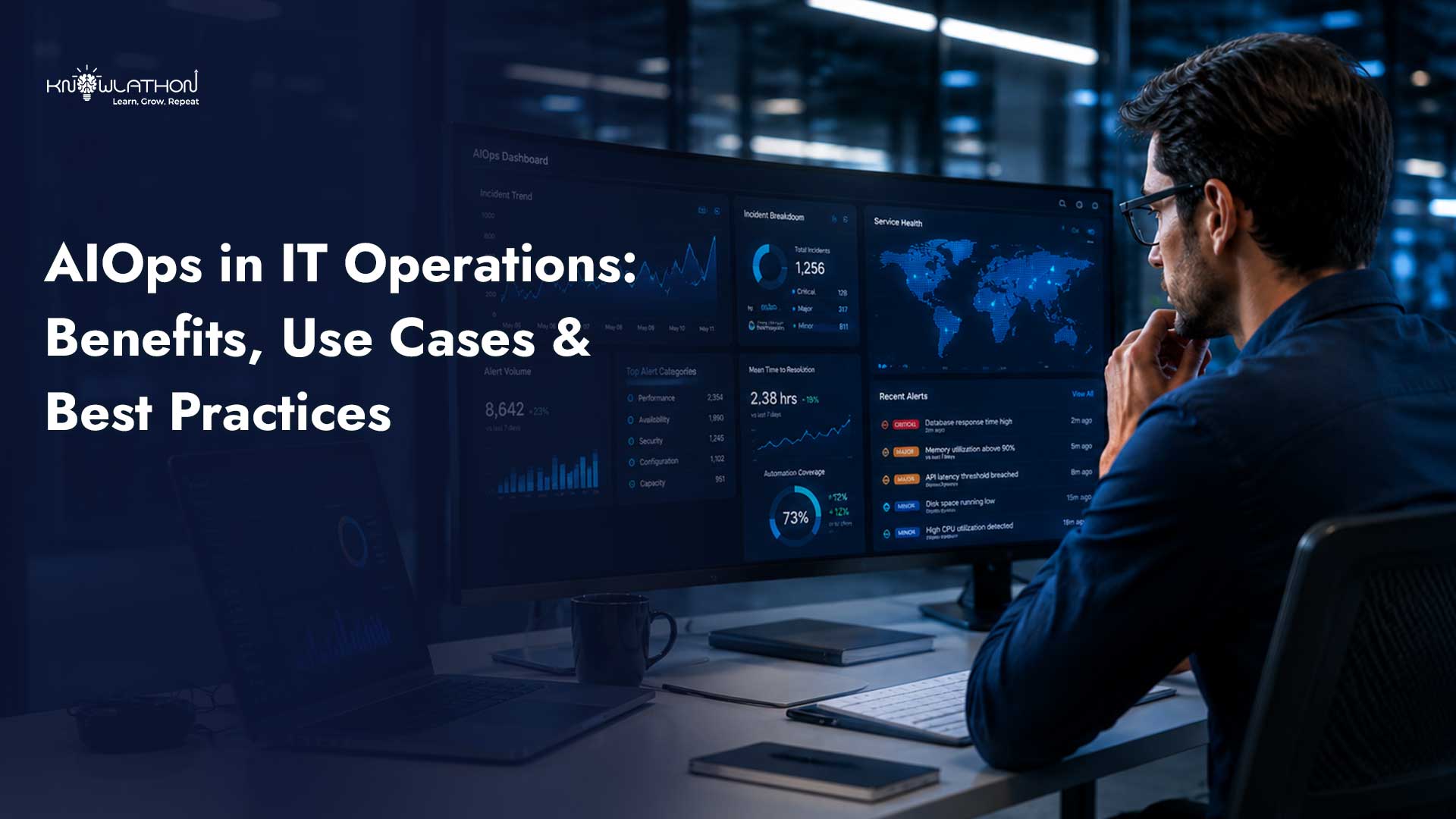
Systems send out thousands of log messages every hour. Most of them are harmless noise. Smart algorithms analyze this incoming flood and group related alerts together. You only see one main incident ticket instead of fifty duplicate alerts.
2. Prediction: Stopping Threats Before Outages
Instead of waiting for a server to crash, predictive models watch performance trends. If disk space drains unusually fast, the platform flags it early. You get a heads-up before users even notice a slowdown.
3. Automation: Handling Routine Tasks
Fixing simple errors takes up way too much time. Once an issue gets identified, automated scripts trigger instantly. Restricting access or restarting a frozen service happens in seconds without human intervention.
4. Mitigation: Resolving Outages Smoothly
When major incidents happen, getting systems back online is critical. Intelligent tools point engineers directly to the root cause. This cuts down mean time to resolution and protects your business from expensive downtime.
Real-World AIOps Use Cases
Practical application is where this technology really shines. Here are a few common AIOps use cases you will see in modern workplaces:
- Event Correlation: Merging alerts from multiple cloud tools into one central dashboard.
- Root Cause Analysis: Identifying probable root-cause candidates and contributing components.
- Capacity Planning: Analyzing historical usage patterns to predict future server storage needs accurately.
- Self-Healing Infrastructure: Triggering auto-remediation scripts to reset glitched network ports automatically.
Who Should Learn AIOps and Take Certification?
This technology is expanding rapidly across every industry. If you work in technology, learning these skills keeps your career relevant and competitive. You should consider an AIOps certification if you work as:
- IT Operations Specialists and System Administrators
- DevOps Engineers and Site Reliability Engineers (SREs)
- Infrastructure Managers and Cloud Architects
- IT Service Management (ITSM) Professionals
- Technical Consultants looking to upgrade their skills
Are There Prerequisites for Getting Certified?
You do not need a deep background in data science or complex coding to start learning. Having a basic grasp of IT service management concepts helps a lot. Knowing how servers, networks, and cloud environments interact gives you a solid head start. If you already understand basic IT workflows, you are completely ready to dive in.
Why Choose Knowlathon for Your Training Journey?
Picking the right learning partner makes a massive difference in how well you learn new concepts. At Knowlathon, we don’t just dump theoretical slides on you. We focus on real-world scenarios, practical exercises, and interactive learning. Our accredited trainers guide you step by step through every module so you feel confident. We offer flexible course schedules, practice exams, and dedicated support — enough to make sure you clear your certification test on your first attempt.
Winding Up Thoughts
Problems are certainly not going away any time soon in IT environments. There is no way for people to effectively analyze tens of thousands of system logs by hand, but automation helps you avoid firefighting every day and improve systems instead. Learning automation now puts you ahead in the game of enterprise IT management.