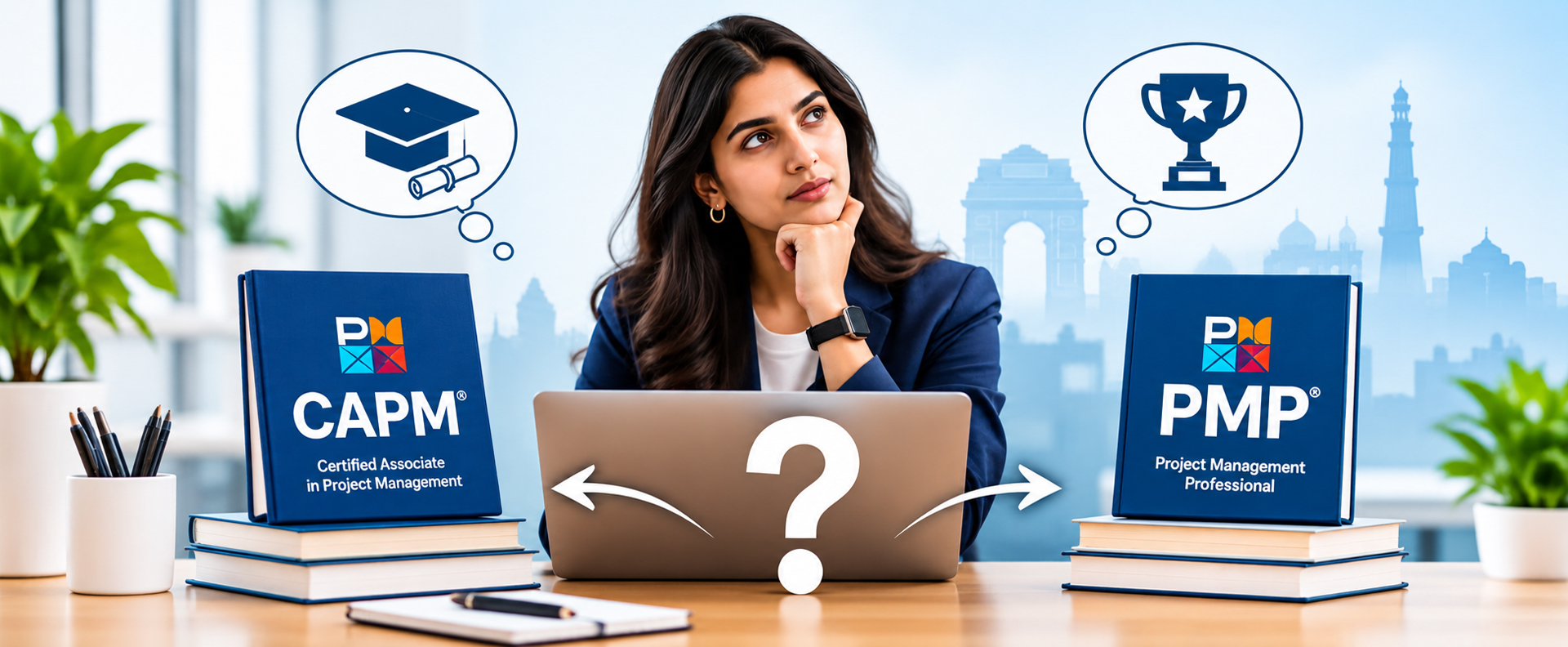
You’ve just finished college, or you’re moving into project work from another field, and you want a PMI credential on your resume. Then you notice that everyone online says something different. One person swears by the PMP. Another says start small, so who’s right? Both, actually, but for different people. Here’s how CAPM vs PMP breaks down for you in India, from eligibility and cost to pay and timing.
The CAPM certification is PMI’s entry-level credential, and you can earn it without any work experience. The PMP is PMI’s senior-level credential, and it asks you to prove years of real project leadership first. Think of CAPM as the way through the door, and PMP as the way up once you’re inside. Now let’s shed light on who can sit in each exam.
Who Can Sit Each Exam
CAPM asks for a secondary degree and 23 hours of project management education. That’s it. No experience needed.
The PMP asks for more. With a four-year degree, you need 36 months of experience leading projects plus 35 hours of project management education. With a secondary diploma, it’s 60 months of experience plus the same 35 hours.
| Factors | CAPM | PMP |
|---|---|---|
| Work experience | None | 36 or 60 months |
| Education hours | 23 | 35 (an active CAPM covers this) |
| Exam | 150 questions, 3 hours | 180 questions, about 3 hours 50 minutes |
| Exam fee in India (member / non-member) | ₹15,247 / ₹20,265 | ₹27,406 / ₹55,488 |
Those rupee fees come from Simpliaxis, which reports PMI’s store prices from September 2026. Fees move with exchange rates and taxes, and PMI membership costs extra, so check PMI’s site before you pay.
CAPM vs PMP Salary
Let’s be honest about the data first. Pay figures for these credentials come from salary portals and training sites, not from PMI, so they’re rough guides. They also mix in experience, since PMP holders are usually further along in their careers.
With that said, NovelVista’s 2026 comparison puts CAPM holders in India at about ₹5 to ₹8 lakh a year and PMP holders at about ₹12 to ₹18 lakh.
The CAPM vs PMP Salary Difference in India
Put those ranges side by side and the gap is roughly ₹7 to ₹10 lakh a year. Don’t read that as “PMP adds ₹8 lakh to your paycheck.” Most of that gap comes from time. A PMP holder has spent three to five years or more running projects, and employers pay for that experience. The credential helps you prove it. Training providers also point to PMI’s own salary survey, which reports that PMP holders earn noticeably more than non-certified peers in the same field.
The practical takeaway is simple. CAPM helps you reach the first salary band. PMP helps you move into the next one.
CAPM vs PMP for Freshers in India
If you’re a fresher, this part is quick. You can’t sit the PMP at all, because you haven’t logged the experience. CAPM is your only PMI option, and it fits roles like project coordinator, PMO analyst, and junior business analyst in IT services, banking, and consulting.
Keep your expectations realistic, though. CAPM won’t hand you a project manager title. What it does is get your resume past a first filter and show hiring managers that you understand how projects work. The rest comes from the job you land and the work you do in it.
Is CAPM Worth It Without Work Experience?
Yes, with one condition. It’s worth it if you’re aiming for entry-level project roles and you want proof of knowledge before you have a track record.
The cost is small compared with the PMP, with an exam fee near ₹15,000 to ₹20,000 plus the price of your 23 hours of training. It’s also the only PMI exam you can take with zero experience. And the education hours it gives you count toward the 35 hours the PMP asks for later, so the effort isn’t wasted.
Skip it, though, if you already have three or more years of project leadership behind you. In that case you’d be paying for a lower credential when you could aim at the one employers weigh more.
Should I Do CAPM or PMP First?
Use your experience as the deciding factor.
- Under about three years of project work: Start with CAPM. You aren’t eligible for the PMP yet anyway.
- Three years or more (four-year degree) or five years or more (diploma): Go straight to the PMP. A CAPM first would just add a second fee.
- Somewhere in the middle: Count the months. If you’re close to the PMP threshold, you might wait and sit the PMP instead.
If you start with CAPM, treat it as a stepping stone. Earn it, work on real projects for a few years, and then move up to the PMP when you qualify. That path gives you both a foundation and a track record.
Start Your CAPM or PMP Prep with Knowlathon
At Knowlathon, we help you pick the right PMI path and get ready for it. As a PMI Authorized Training Partner, we run live sessions with practice questions, so you can build your meaningful education hours with a provider PMI recognizes. If you’re not sure where you stand, tell us your experience and your goals, and we’ll point you to the right first step.
And if you already know the exam you want to sit for, whether it’s the CAPM or the PMP, then the next thing you have to do is quite simple. Choose the date that fits well into your schedule for the week and we will arrange everything accordingly. We provide you with audio recordings in case you miss out on anything, as well as assistance in applying for PMI.