Introduction
In today’s hyper-digital landscape, organizations rely on robust IT Service Management (ITSM) frameworks to ensure seamless operations, enhanced customer satisfaction, and optimized business outcomes. Among these, ITIL (Information Technology Infrastructure Library) remains the most widely adopted framework, guiding IT professionals through structured service delivery practices.
Whether you’re targeting a role in IT operations, service management, or enterprise IT strategy, having a strong grasp of ITIL principles can set you apart in interviews. This blog presents 50 carefully curated ITIL interview questions and answers, covering ITIL fundamentals, v4, v5, Bridge Courses, and practical scenarios — enabling candidates to demonstrate technical know-how, process awareness, and strategic insight.
ITIL Fundamentals
1. What is ITIL?
ITIL is a globally recognized framework for IT service management. It outlines best practices for planning, delivering, and supporting IT services aligned with business goals. Learn more in our ITIL Foundation Course.
2. Why is ITIL important for organizations?
ITIL helps organizations reduce downtime, optimize costs, improve service quality, and strengthen customer satisfaction, making IT a strategic enabler.
3. What does ITSM mean?
IT Service Management (ITSM) is the discipline of managing IT services to deliver value to customers efficiently.
4. Name the five stages of the ITIL v3 service lifecycle.
Service Strategy, Service Design, Service Transition, Service Operation, and Continual Service Improvement (CSI).
5. What is a Service Lifecycle?
Represents the full lifecycle of IT services — from ideation and design to delivery, operation, and ongoing improvement.
6. What are ITIL’s core objectives?
To deliver value, ensure service reliability, align IT with business, improve user experience, and reduce operational risks.
7. Define Incident Management.
Process of restoring normal service quickly after a disruption to minimize business impact.
8. What is a KPI (Key Performance Indicator)?
A measurable value used to evaluate service or process performance against predefined objectives.
9. What is an SLA (Service Level Agreement)?
Formal agreement between IT and the customer, defining service expectations, availability, and performance metrics.
10. What is an OLA (Operational Level Agreement)?
Internal agreement between teams that ensures SLAs are met, outlining responsibilities and collaboration standards.
ITIL Processes & Problem Handling
11. What is a Workaround?
Temporary solution to reduce the impact of incidents until a permanent fix is implemented.
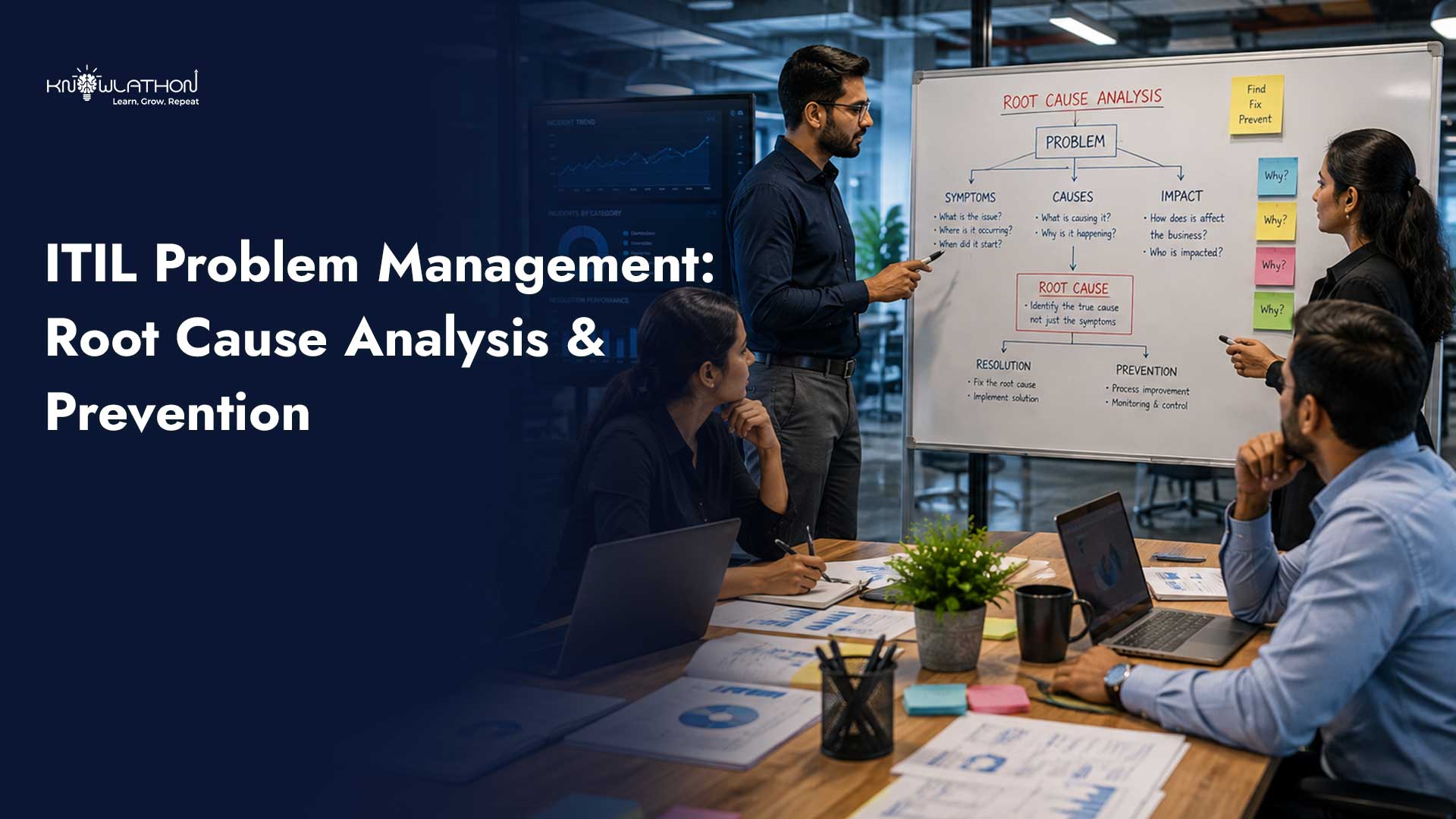
12. Explain Root Cause Analysis.
Systematic approach to identify the underlying cause of recurring incidents or problems.
13. What is Problem Management?
Process focused on preventing recurring incidents by analyzing root causes and implementing preventive measures.
14. Define Change Management.
Change Management controls all IT changes to minimize risk while maintaining service quality.
15. What is a Standard Change?
Pre-approved, low-risk change with established procedures, requiring minimal review.
16. What is a Configuration Baseline?
Snapshot of agreed-upon configuration items (CIs) serving as a reference for changes and audits.
17. Difference between a Project and a Process?
Project: temporary with defined objective; Process: continuous and repeatable.
18. What is Problem Detection?
Identifying potential service issues proactively to prevent incidents and reduce downtime.
19. What is a Change Advisory Board (CAB)?
Team that reviews, approves, and advises on change requests, ensuring minimal business impact.
20. Define Continual Service Improvement (CSI).
Ongoing process that evaluates and enhances services and processes, focusing on value creation. Explore ITIL CSI Best Practices.
Service Management Concepts
21. What is a Service Request?
Formal request from a user for information, access, or service, such as password resets or new software installations.
22. Difference between Incident and Service Request?
Incidents: unplanned service interruptions
Service Requests: planned user needs
23. What is a Service Catalogue?
Centralized repository of all IT services, including descriptions, SLAs, and request procedures.
24. What are the 4 P’s of Service Management?
People, Processes, Products, and Partners — the pillars of effective IT service delivery.
25. Explain Balanced Scorecard in ITIL.
Strategic tool aligning IT activities with business objectives, measuring performance across multiple dimensions.
26. Purpose of Capacity Management?
Ensure IT infrastructure meets current and future business demands efficiently and cost-effectively.
27. What is a Known Error?
Problem with documented root cause and a temporary workaround available for incidents.
28. Define Financial Management in ITIL.
Responsible for budgeting, accounting, and controlling IT service costs. Related: ITIL Financial Management Overview.
29. What is Knowledge Management?
Capturing, sharing, and utilizing organizational knowledge to improve decision-making and efficiency.
30. What is Event Management?
Monitoring and categorizing events to detect, analyze, and respond to operational alerts in real-time.
ITIL Roles & Responsibilities
31. What is a CMDB?
Configuration Management Database stores IT assets, configuration items, and their interrelationships. Learn more in ITIL CMDB Guide.
32. Explain the RACI model.
Defines who is Responsible, Accountable, Consulted, and Informed for each process activity.
33. Examples of Service Lifecycle models?
Microsoft MOF, HP ITSM Reference Model, IBM IT Process Model — supporting ITIL adoption in enterprises.
34. What is a Freeze Period?
Restricted timeframe where changes are limited to stabilize critical systems.
35. Purpose of ITIL Service Desk?
Central contact point for logging, managing, and resolving user incidents and service requests.
36. Who maintains the Known Error Database?
Problem Manager ensures it’s updated with all known errors and workarounds.
37. Define Service Strategy.
Phase focused on aligning IT services with business objectives, defining value and service models.
38. Define Service Operation.
Ensures effective and efficient delivery of IT services.
39. Purpose of Service Transition?
Deploy new or modified services safely into operational environments. See ITIL Service Transition Guide.
40. Define Service Design.
Designing IT services, processes, and policies to meet business requirements effectively.
Advanced ITIL Topics
41. What is ISO/IEC 27002?
Standard providing guidelines for information security management best practices.
42. Proactive vs Reactive Problem Management?
Proactive: prevents incidents using trend analysis
Reactive: responds after disruptions occur
43. What is a Service Pipeline?
Services under development or planned but not yet available to end-users.
44. Difference between Service Pipeline and Service Catalogue?
Pipeline: future-focused
Catalogue: currently available services
45. Urgent vs Emergency Change?
Emergency: fixes critical failures immediately
Urgent: high priority but less critical
46. What is Post Implementation Review (PIR)?
Assessment after deployment to ensure objectives are met and lessons learned.
47. Purpose of a Workaround?
Temporarily mitigates impact before permanent solutions are applied.
48. Difference between Problem and Known Error?
Problem: root cause unknown
Known Error: root cause identified with a documented workaround
49. Examples of proactive Problem Management?
Trend analysis, preventive actions, and performance monitoring to reduce recurring incidents.
50. What are the 7 R’s of Change Management?
Raised by, Reason, Return required, Risk assessment, Resources, Responsible person, Relationships — checklist for evaluating changes.
Conclusion
This comprehensive ITIL interview guide equips aspirants with knowledge of frameworks, processes, and practical ITSM scenarios. Mastery of these questions demonstrates technical expertise, process insight, and strategic thinking, essential for roles in IT service operations, project management, and enterprise IT leadership.
Boost your career by exploring Knowlathon ITIL Courses, including ITIL v4, ITIL v5, and Bridge Courses, with expert trainers and globally recognized certification pathways.